
Britain Is Building a Lab Where AI Watches for the Next Biological Threat
The UK government will put £100 million into an AI Biosecurity Lab it calls the first organisation of its kind anywhere — an independent non-profit that will use frontier AI models to detect biological threats earlier and speed up vaccines, with OpenAI and Anthropic pledging up to £200 million more in credits and access.
A new kind of national lab
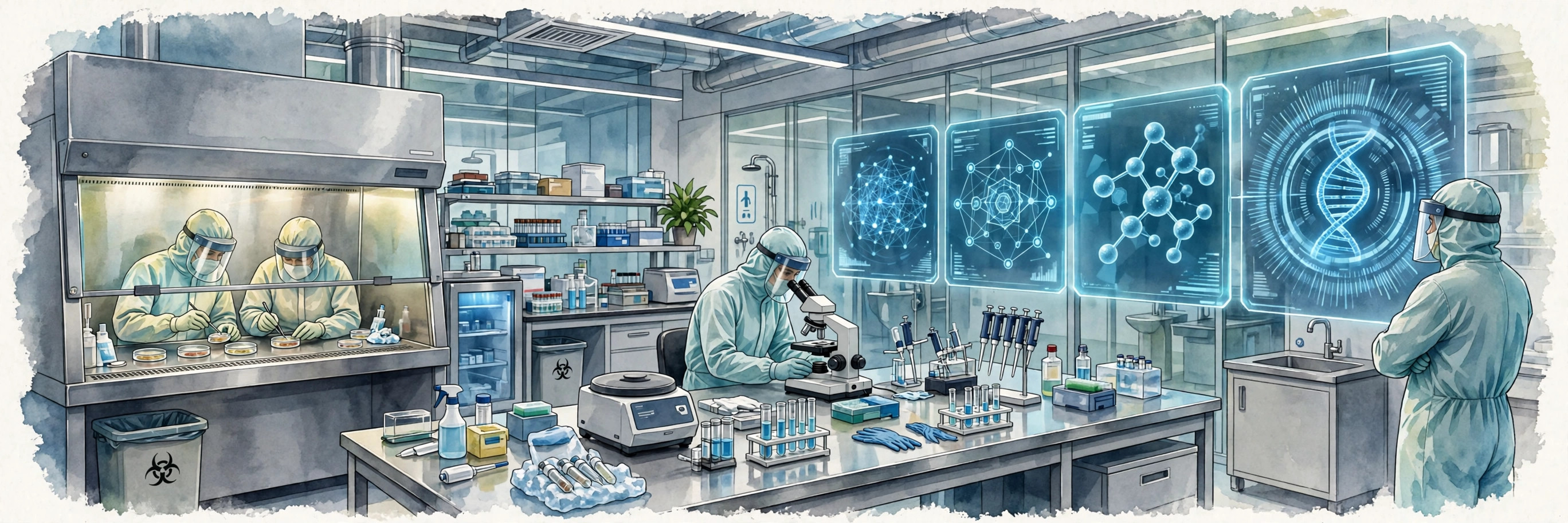
Britain is setting up an institution built around an uncomfortable symmetry: the same artificial intelligence that could help design a biological weapon could also be the tool that spots one coming. On 24 October, the Cabinet Office announced the AI Biosecurity Lab, which the government describes as the world's first organisation dedicated solely to AI biosecurity. It will be funded with £100 million of public money and run as an independent non-profit, structured to hire top scientific and technical talent and move quickly — a model consciously borrowed from the UK's AI Security Institute.
The lab sits inside a new National AI Biosecurity Initiative worth £165 million in total: the £100 million for the lab, plus £65 million to strengthen biosurveillance and to develop medical countermeasures against priority pathogens. The announcement forms part of a wider package of more than £600 million for AI security set out ahead of this week's Budget.
What the lab is actually for
The stated first jobs are two: earlier detection of emerging biological threats, and faster development of vaccines, treatments and other countermeasures when a threat appears. The government's reasoning cuts both ways, and it says so openly — more capable AI creates unprecedented opportunities for scientific discovery, but it also creates new biological risks and could lower the barriers to harmful activity. The lab is meant to work the defensive side of that equation: using frontier models, under controlled conditions, to understand what the technology makes possible before someone with bad intent does.
Around it will sit the state's existing machinery. The UK Health Security Agency, the Animal and Plant Health Agency and the Defence Science and Technology Laboratory are all part of the wider initiative, and the medicines regulator, the MHRA, will advise on preparing for health emergencies and on how medicines designed with AI should be regulated. A scientific advisory committee drawn from academia, industry and the third sector is to follow.
The AI companies are paying — in kind
The headline backing from industry is large, but it needs reading precisely. OpenAI and Anthropic have pledged up to £200 million between them — not in cash, but in compute and model credits, trusted access to their most capable relevant models, and technical support. OpenAI's £100 million share runs through its Rosalind Biodefense programme, which sponsors trusted access to its life-sciences models. Anthropic's share, worth up to £100 million, combines credits and model access with dedicated support from its staff.
Google DeepMind and the British AI life-sciences firm Basecamp Research join as research partners rather than funders, with no money figure attached: DeepMind is expected to provide trusted access to its Gemini and specialised science models and to collaborate through its own scientists, while Basecamp will open up its AI-biology models and expertise. AI minister Kanishka Narayan called the lab "a major new global institution," saying it would bring together world-leading expertise to protect people from emerging biological threats.
Why it matters beyond Britain
Biosecurity has quietly become one of the arenas where governments most want frontier AI companies inside the tent. Testing what a model can and cannot do in biology, under government-sanctioned conditions, is now treated in London — as in Washington — as basic national infrastructure rather than an academic exercise. An independent, publicly funded lab with the major model-makers contractually involved is the institutional form that idea has taken in the UK. Whether it detects anything that matters, and how its findings are shared with allies, will decide if the model is copied elsewhere — including, eventually, in countries like India that run large vaccine and biotech industries of their own.