
Four Launch Pads by 2029: ISRO Lays Out India's Bigger, Busier Spaceport Map
ISRO chairman V. Narayanan says India will have four functional launch pads by 2029 — a third at Sriharikota and a brand-new small-satellite spaceport spread over some 2,000 acres at Kulasekarapattinam in Tamil Nadu — as the agency leans on private firms to meet demand for thousands of satellite launches.
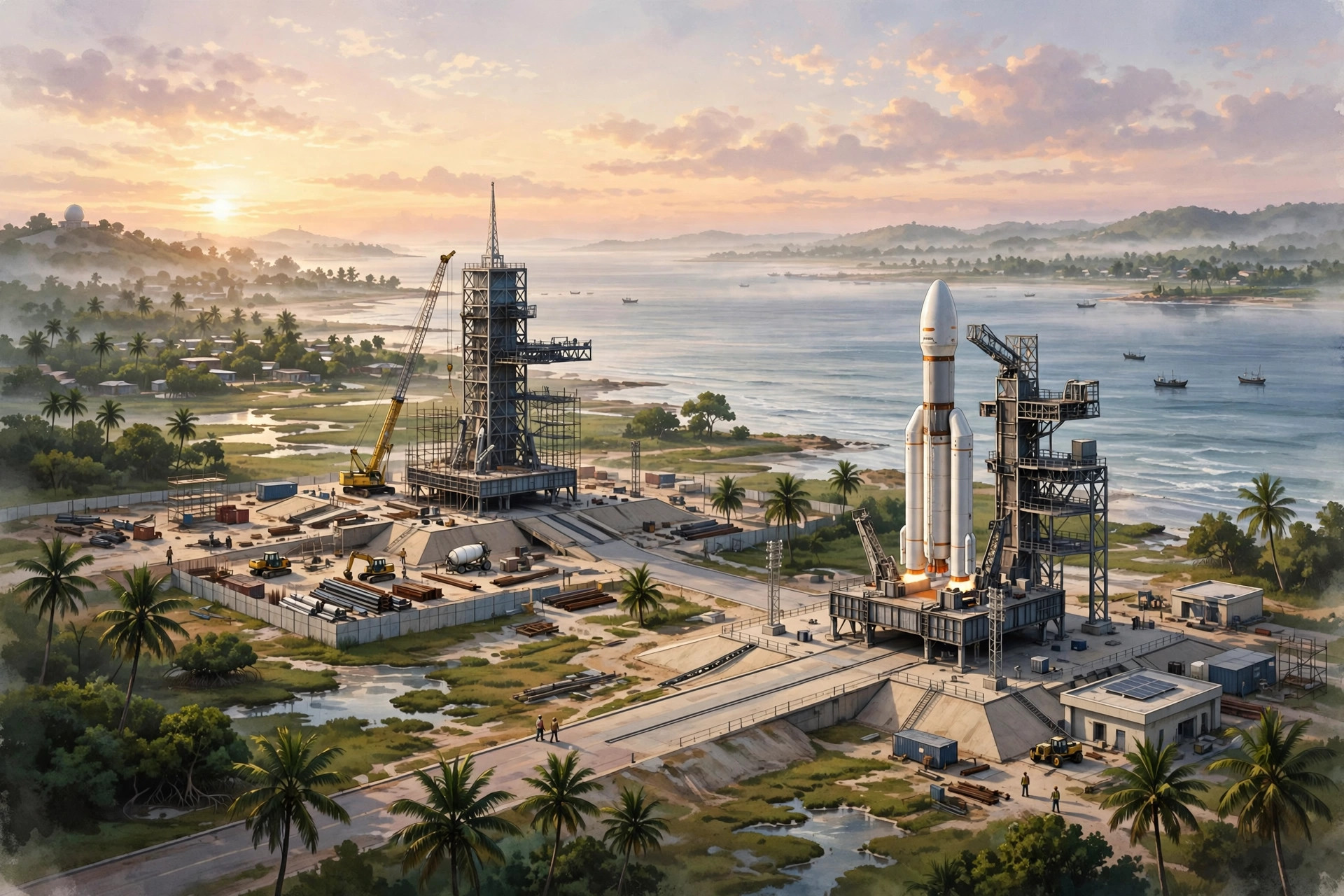
From two pads to four
India's space programme has flown almost everything it owns from one patch of Andhra Pradesh coastline. That is about to change. ISRO chairman V. Narayanan has said the country will expand to four functional launch pads by 2029, pairing growth at the existing Sriharikota spaceport with an entirely new launch site in Tamil Nadu built for small rockets.
Narayanan, who is also Secretary of the Department of Space, laid out the roadmap on Saturday 24 October while speaking at a graduation ceremony at the Sri Ramachandra Institute of Higher Education and Research in Porur, near Chennai. The Satish Dhawan Space Centre at Sriharikota currently operates two active pads, which between them handle the PSLV, GSLV, LVM3 and SSLV fleets. A third pad is under development at the same site, with readiness targeted around March 2029. The fourth pad comes from the south.
Kulasekarapattinam: a spaceport built for small satellites
The new site is rising at Kulasekarapattinam, in Thoothukudi (Tuticorin) district, where the government is developing a dedicated Small Satellite Launch Vehicle complex over roughly 2,000 acres. Its location is the point: rockets flying south from Kulasekarapattinam can head more directly into polar orbits without the dogleg manoeuvre Sriharikota launches need to avoid overflying land, which makes the site well suited to the small-satellite traffic ISRO wants more of, and takes pressure off Sriharikota's crowded manifest.
This will not be a lone concrete pad. According to Narayanan, the complex will include integration buildings where rockets are assembled, launch pads, rail-track systems for moving vehicles, telemetry, tracking and command infrastructure, range and checkout systems, safety facilities and civic amenities — in effect, a small industrial town organised around launching. The foundation stone for the complex was laid in February 2024 and construction began in March 2025; the first rocket launch from the site is expected in 2027, ahead of the full four-pad configuration in 2029.
Not privatisation — but private partners everywhere
Narayanan was careful on one point that has followed India's space reforms for years: ISRO itself, he said, will not be privatised. What will change is who does the flying around it. With domestic and global customers wanting thousands of satellites launched, he argued, the national agency cannot scale alone, and partnerships with private companies and startups are essential to handle commercial operations.
"To handle this expanding ecosystem, ISRO will handhold startups and private enterprises," he said, describing technology transfer and mentoring intended to foster economic growth and generate thousands of high-tech jobs. The launch-pad expansion and the industry policy are two halves of one plan: more pads create the capacity, and a broader ecosystem of private operators and suppliers fills it.
The human spaceflight thread
The same address carried an update on Gaganyaan, India's human spaceflight programme. Narayanan said ISRO plans to fly the first uncrewed Gaganyaan test within the next two months, followed by two more uncrewed missions before astronauts fly. The tests will evaluate environmental control, safety systems, crew-escape mechanisms and module interiors under varying pressure, temperature and humidity. He said the agency has completed roughly 8,000 ground-based experiments for the mission, and that four astronaut-designates are in specialised training.
Put together, the picture from Chennai is of a programme widening on every axis at once — more launch sites, more vehicles, private companies moving from suppliers towards operators, and a crewed capsule approaching its first flights. The 2029 date for four working pads is the concrete marker. MagnetDaily will track the Kulasekarapattinam build and the first launch expected there in 2027.